

China just delivered a seismic leap forward in the global AI race. The Shanghai Artificial Intelligence Laboratory has unveiled DeepLink, a groundbreaking hybrid inference and cross-domain training solution that seamlessly unifies heterogeneous chips from multiple vendors into a single, high-performance computing powerhouse. Announced on March 23, 2026, this innovation directly tackles one of Beijing’s biggest pain points: fragmented computing resources and heavy reliance on any single chip architecture amid ongoing U.S. export restrictions.

By linking diverse AI accelerators—whether domestic GPUs from Huawei, Biren, or Moore Threads, or even mixed international hardware—DeepLink turns isolated data centers into unified “supernodes.” Early real-world tests already show massive gains in efficiency, model training speed, and overall computing utilization. For Chinese AI developers, cloud providers, and national infrastructure projects, this isn’t just an upgrade—it’s a strategic game-changer that could slash costs, boost performance, and accelerate self-reliance. Here are the six game-changing ways DeepLink is poised to supercharge China’s AI ambitions in 2026 and beyond.
The Breakthrough That Changes Everything
DeepLink emerged from years of focused R&D at Shanghai AI Lab, one of China’s premier hubs for cutting-edge artificial intelligence. The solution combines advanced software frameworks like DiTorch (a unified PyTorch-compatible interface) and DiComm (optimized RDMA communication) to create a hyper-heterogeneous training environment capable of scaling to over 1,000 chips of wildly different architectures.
In a landmark demonstration, DeepLink “split” two China Unicom intelligent computing centers 1,500 kilometers apart—Shanghai and Jinan—into one virtual supernode. The result? Successful mixed training of a 100-billion-parameter large language model across entirely different hardware ecosystems. This hyperscale cross-domain approach solves the chronic problems of uneven computing power distribution and underutilized clusters that have plagued China’s AI infrastructure.
1. True Heterogeneous Collaboration That Maximizes Every Chip
Traditional AI clusters demand homogeneity—every GPU must match, or performance collapses. DeepLink shatters that limitation. It dynamically balances workloads across chips with varying compute capabilities, memory sizes, and interconnect speeds, delivering superlinear speedups of up to 16.37% compared to homogeneous baselines.
Engineers no longer waste resources on idle hardware. Instead, DeepLink’s HeteroPP (heterogeneous pipeline parallelism) and HeteroAuto algorithms intelligently allocate tasks, ensuring every chip contributes at peak efficiency. For cash-strapped developers or national-scale projects, this means squeezing dramatically more performance from existing—and often mismatched—installations.
2. Long-Distance Supernode Integration That Defies Geography
One of DeepLink’s most audacious feats is bridging vast distances without sacrificing speed. By leveraging China Unicom’s AINET intelligent computing network, the system treats physically separated clusters as a single logical entity. The 1,500 km Shanghai-Jinan link proved that hyperscale mixed training is not only possible but highly efficient.
This geographic flexibility is revolutionary for a country as vast as China. Remote western data centers can now pool resources with eastern coastal hubs, eliminating “computing deserts” and optimizing national infrastructure utilization. The implications for edge AI, scientific research, and industrial applications are enormous.
3. Drastic Reduction in Vendor Lock-In and Supply Chain Risks
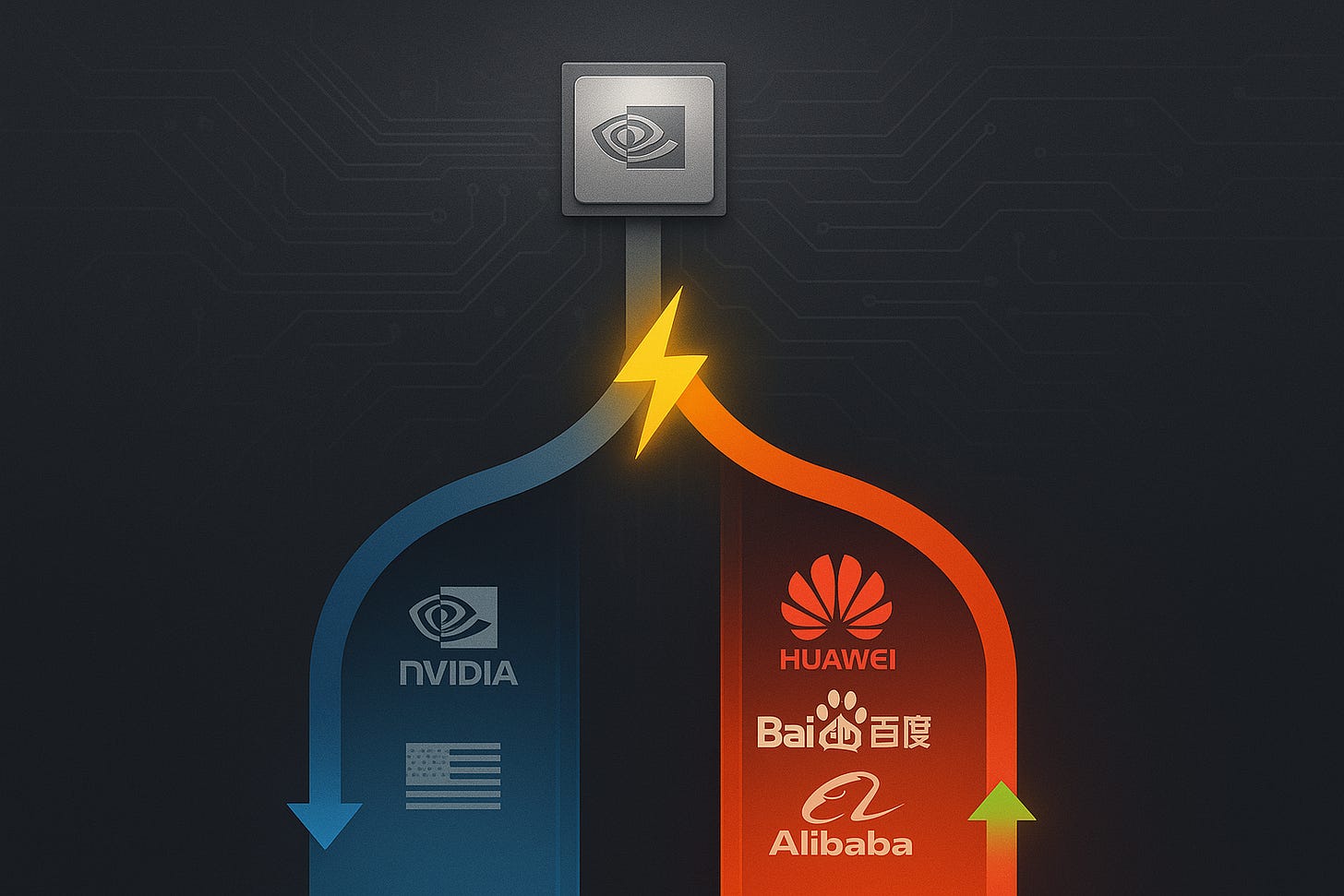
U.S. export controls have forced Chinese firms to diversify beyond NVIDIA. DeepLink turns that necessity into a superpower. By providing a vendor-agnostic layer—supported by standards like DIOPI with over 300 operator interfaces—it lets developers mix and match chips freely without rewriting code or retraining models.
The result? Lower costs, faster deployment, and genuine resilience. Companies can blend Huawei Ascend, Biren BR100, Moore Threads MTT, and even legacy international hardware in the same cluster. No more betting everything on one supplier—DeepLink makes heterogeneous computing the new normal.
4. Explosive Efficiency Gains for Large Language Models
Benchmarks from Shanghai AI Lab’s H2 framework (HyperHetero) show DeepLink excelling at training massive LLMs on hyper-heterogeneous clusters. The system handles memory constraints, communication overhead, and load balancing with adaptive intelligence, delivering consistent superlinear performance improvements.

For inference workloads, the hybrid solution shines even brighter, optimizing real-time serving across mixed accelerators. Early adopters report significantly lower energy consumption and higher throughput—critical advantages as China scales AI to industrial levels while managing power grids and sustainability goals.
5. National-Scale Impact on Cloud Providers and Industry
China Unicom’s successful deployment proves DeepLink’s readiness for prime time. Major carriers and cloud giants can now federate computing power nationwide, creating a unified “computing power market” that functions like electricity or oil—tradable, efficient, and always available.
Industries from autonomous driving and smart manufacturing to healthcare and scientific simulation stand to benefit. By unlocking underused hardware, DeepLink could add billions in effective compute capacity without building new data centers—exactly what Beijing’s latest five-year plan demands for AI leadership.
6. Strategic Boost to China’s AI Self-Reliance and Global Competitiveness
In an era of geopolitical tech tensions, DeepLink delivers a masterstroke of independence. It reduces dependence on any single foreign ecosystem while accelerating domestic innovation. Combined with parallel efforts like Huawei’s Ascend platform and open alliances, it positions China to maintain momentum even under the tightest sanctions.
Analysts see this as a pivotal step toward a fully sovereign AI stack. With DeepLink, the country can train frontier models faster, serve more users cheaper, and export its unified computing approach to Belt and Road partners—potentially reshaping global AI infrastructure.
Head-to-Head: DeepLink vs. Traditional Homogeneous Computing
| Aspect | Traditional Homogeneous Clusters | DeepLink Heterogeneous System |
|---|---|---|
| Chip Compatibility | Single vendor only | Any mix of vendors/architectures |
| Resource Utilization | Often 60-70% | Up to 16%+ superlinear gains |
| Geographic Flexibility | Limited to local clusters | 1,500+ km supernodes proven |
| Vendor Lock-In | High | Near zero |
| Training Speed (100B model) | Baseline | Significantly faster & more efficient |
| Energy & Cost Efficiency | Standard | Dramatically improved |
The contrast highlights why DeepLink is being hailed as a national strategic asset.
Real-World Momentum and What Comes Next
Shanghai AI Lab has already open-sourced key components like DiTorch and DIOPI, inviting the broader ecosystem to build on the foundation. China Unicom’s deployment marks the first commercial-scale success, with more carriers and hyperscalers expected to follow rapidly.
Looking ahead, DeepLink will integrate deeper with national computing networks, support even larger models, and expand into edge and industrial scenarios. For global observers, it signals that China is not merely catching up—it is pioneering practical solutions to the very constraints designed to slow it down.
Why This Matters for the Entire AI World
DeepLink proves that software ingenuity can overcome hardware fragmentation. As AI compute demand explodes worldwide, the ability to unify diverse chips offers lessons far beyond China’s borders. Cloud providers everywhere face similar challenges of mixed fleets and rising costs—DeepLink’s open approach could inspire similar frameworks globally.
For China, it’s a clear win for self-reliance, efficiency, and scale. The technology directly supports the country’s 2026-2030 five-year plan priorities, turning potential weaknesses into strengths.
Final Verdict: DeepLink Is the AI Computing Unifier China Needed
The revolutionary DeepLink solution from Shanghai AI Laboratory isn’t hype—it’s a meticulously engineered leap that unifies heterogeneous chips, shatters geographic barriers, slashes waste, and supercharges AI performance at national scale. With six game-changing capabilities already proven in real deployments, it delivers exactly what China’s AI ecosystem has been craving: flexible, efficient, sovereign computing power.
As the rollout accelerates through 2026, expect DeepLink to become the invisible backbone powering everything from next-generation large models to smart-city infrastructure. In a world still grappling with chip shortages and export controls, this breakthrough shows how bold software innovation can rewrite the rules of the AI race.
China’s computing power just got a whole lot smarter—and the rest of the world is watching closely. The era of truly unified, hyper-heterogeneous AI has arrived, and DeepLink is leading the charge.
Discover more from Tech-Brunch
Subscribe to get the latest posts sent to your email.


