Rooftop Solar Giants are tackling and crushing load-shedding. South Africa has enjoyed a remarkable respite from widespread load-shedding since mid-2024, with Eskom’s improved performance, reduced unplanned outages, and a surge in private renewable energy playing key roles. While utility-scale projects face grid constraints, a handful of innovative companies have stepped up quietly but powerfully, installing hundreds of megawatts of rooftop solar on businesses, factories, malls, and homes.
These behind-the-meter installations bypass transmission bottlenecks entirely, delivering reliable power directly where it’s needed and meaningfully easing pressure on the national grid.
As of early 2026, the National Transmission Company of South Africa estimates around 7,500MWp of private “behind-the-meter” solar capacity nationwide, much of it from commercial and industrial rooftops. Since 2018, Nersa has registered over 18,000MW of private generation, with rooftop solar forming a massive share. These efforts represent a distributed energy revolution that’s helping sustain the no-load-shedding streak while supporting economic recovery.
The Rise of Rooftop Solar Giants
In recent years, specialized firms have emerged as leaders in large-scale rooftop solar deployments. They focus on commercial and industrial (C&I) clients, offering turnkey solutions that include financing, installation, and often battery energy storage systems (BESS) for backup during non-sunny periods or peak demand.
These companies operate under models like power purchase agreements (PPAs), where clients pay for electricity generated rather than upfront capital costs—making adoption easier for businesses facing high tariffs and unreliable supply.
7 Leading Rooftop Solar Players Fighting Load-Shedding
Here are some of the standout companies highlighted in recent reports, ranked roughly by installed or committed rooftop solar capacity:
1. Terra Firma – Over 350MWp Installed
Terra Firma leads with more than 350MW across 500+ projects, powering factories, warehouses, and commercial sites nationwide.
2. Solareff (Stanlib Asset Management) – Over 280MWp + 47MWh BESS
Backed by asset management giant Stanlib, Solareff has delivered 280MWp of rooftop solar plus significant battery storage, focusing on high-impact industrial clients.
3. BrightBlack Energy – Notable Projects Including Mercedes-Benz
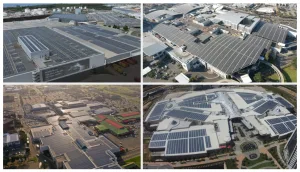
BrightBlack has installed systems like the 14.57MWp array at Mercedes-Benz’s East London factory, one of the largest single-site rooftop setups.
4. SolarAfrica Energy – 30,000+ Panels Equivalent
SolarAfrica stands out with massive deployments, including equivalents to over 30,000 solar panels in various projects, emphasizing scalable C&I solutions.
Other prominent players include firms handling iconic installations at Ford’s Silverton plant and numerous retail and manufacturing sites.
These giants collectively account for hundreds of megawatts that offset Eskom demand during daylight hours, reducing the risk of load-shedding spikes.
Why Rooftop Solar Matters in 2026
Utility-scale renewables in the sunny Cape provinces face transmission limits, slowing expansion. Rooftop and embedded generation sidestep this by generating power at the point of use.
Benefits include:
- Direct load relief — Solar peaks align with high daytime demand, easing grid strain.
- Business resilience — Factories and malls stay operational during potential outages.
- Cost savings — With rising tariffs, self-generation offers long-term affordability.
- Grid support — Reduced reliance on Eskom during peaks helps maintain stability.
Eskom’s own data shows private solar has contributed to the improved energy availability factor (around 62% in 2025), alongside better maintenance and lower diesel use.
Challenges and the Road Ahead
While impressive, rooftop solar isn’t without hurdles: grid access rules designed for larger projects can slow smaller C&I rollouts, and financing remains key for wider adoption.
Looking to 2026 and beyond, experts warn of potential risks around 2029 if reforms stall or coal plants retire without replacements. But the private sector’s momentum—fueled by these solar giants—offers hope for a more distributed, resilient energy future.
In Cape Town, Dona, where sunny weather makes rooftop solar especially viable, many local businesses and homes are already going solar. Have you considered installing panels, or seen more solar setups in your area lately? Share your thoughts below!
Discover more from TECH-BRUNCH
Subscribe to get the latest posts sent to your email.