In a landmark moment for autonomous electric vehicles, Chinese autonomous driving pioneer Pony.ai has officially kicked off mass production of the world’s first electric robotaxi based on Toyota’s bZ4X platform. On February 9, 2026, the company announced that the inaugural Gen-7 bZ4X Robotaxi rolled off the production line at a facility run by the joint venture between Toyota Motor China and GAC Toyota. This achievement signals a decisive shift from experimental testing to scaled commercial deployment in China’s booming robotaxi sector.
Pony.ai (NASDAQ: PONY; HKEX: 2026), a leader in Level 4 autonomous technology, has partnered closely with Toyota since its early investments around 2018–2019. The collaboration deepened in 2024 with the formation of Zhuifeng Intelligent Tech, a joint venture backed by over 1 billion yuan, focused on accelerating mass production and commercialization of driverless vehicles.
The Vehicle: Gen-7 bZ4X Robotaxi Features and Technology
The Gen-7 bZ4X Robotaxi builds directly on Toyota’s all-electric bZ4X compact crossover SUV, which offers a sleek modern design, efficient battery-electric powertrain, and proven reliability. Production takes place at GAC Toyota facilities in China, tailored specifically for the autonomous application.
Key technical highlights include:
- Pony.ai’s seventh-generation (Gen-7) Level 4 autonomous driving system — Fully driverless capability with automotive-grade redundant hardware for maximum safety. The system features 34 sensors: 9 LiDAR units, 14 cameras, and 4 millimeter-wave radars, delivering 360-degree coverage and long-range detection up to 650 meters.
- Significant cost reductions — The bill of materials (BOM) for the autonomous kit has dropped by 70% compared to prior generations, making scaled operations more economically viable.
- Passenger-centric enhancements — Bluetooth automatic unlocking on arrival, seamless in-cabin voice interaction, integrated online music streaming, pre-trip climate control, and intelligently tuned acceleration/braking to minimize motion sickness and deliver a smoother ride.
- Electric performance — Retains the bZ4X’s efficient EV architecture, including recent upgrades like silicon carbide semiconductors in power electronics for improved efficiency and power delivery (up to 163 kW single-motor or dual-motor variants available).
Pony.ai first unveiled the Gen-7 robotaxi lineup (including the bZ4X model) in April 2025, with the other two models (ARCFOX Alpha T5 from BAIC and second-generation Aion V from GAC) already entering commercial service in late 2025.
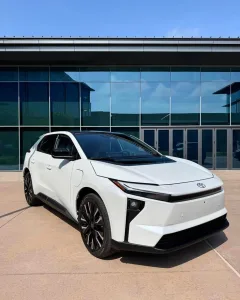
Ambitious Production and Fleet Expansion Goals
The companies plan to produce more than 1,000 Gen-7 bZ4X Robotaxis throughout 2026. This output will directly support Pony.ai’s broader target of expanding its total robotaxi fleet to over 3,000 vehicles by the end of the year.
To put this in perspective:
- Pony.ai’s fleet grew from around 200 vehicles in 2024 to nearly 1,000 by late 2025.
- The addition of the bZ4X models will diversify the fleet, allowing operations across multiple vehicle types in key cities.
- Initial deployments will focus on Tier-1 cities such as Beijing, Shanghai, Guangzhou, and Shenzhen, where Pony.ai already runs paid, fully driverless ride-hailing services.
The bZ4X Robotaxi will gradually integrate into these networks, offering users more options and helping Pony.ai achieve wider coverage and varied riding experiences.
Strategic Partnership and Broader Industry Impact
Toyota’s involvement brings manufacturing scale, supply-chain reliability, and a reputation for safety to the table, complementing Pony.ai’s expertise in AI-driven autonomy, hardware-software integration, and real-world operations.
This collaboration highlights China’s aggressive leadership in autonomous mobility and electrification. With national priorities favoring zero-emission urban transport, the all-electric bZ4X Robotaxi fits perfectly into the ecosystem. Paid robotaxi services from companies like Pony.ai and competitors (Baidu Apollo Go, among others) have already logged millions of rides in permitted zones.
The launch also underscores a trend: traditional global automakers partnering with Chinese tech firms to commercialize advanced tech. Toyota’s early stake in Pony.ai and ongoing joint efforts position it strongly in the robotaxi race, potentially influencing future global strategies.
Future Outlook and Global Ambitions
As production ramps up, the Gen-7 bZ4X Robotaxi is expected to become a familiar sight on Chinese streets, proving the viability of mass-produced autonomous EVs for ride-hailing.
Pony.ai has set even bolder long-term goals, targeting 100,000 vehicles by 2030 to reach full profitability. Internationally, the company is eyeing expansion into the MENA region in the near term, with potential European operations as early as 2027.
For residents in places like Cape Town, Dona, this rapid progress in China serves as a preview of how autonomous electric ride-hailing could transform urban mobility worldwide—offering convenient, emission-free, and potentially more affordable transport in the coming years.
What do you think about this development? Would you feel comfortable hailing a driverless Toyota robotaxi one day? Share your thoughts below!
Discover more from TECH-BRUNCH
Subscribe to get the latest posts sent to your email.