China’s robotics sector has achieved an unprecedented breakthrough, installing a record 295,000 industrial robots in 2024 alone and pushing its operational stock past the explosive 2 million mark. This massive robotics revolution now accounts for over half of global deployments, positioning the nation as the undisputed leader in automation and artificial intelligence integration. What began as a strategic push under national initiatives has evolved into a transformative force reshaping manufacturing, services, and daily life across the country and beyond.
The scale of this progress is staggering. According to the International Federation of Robotics (IFR) World Robotics 2025 report, China’s robot density reached 470 units per 10,000 workers, placing it among the world’s top adopters. Domestic manufacturers captured 57 percent of the home market for the first time, up from 47 percent the previous year, signaling a swift shift from reliance on foreign technology to self-reliant innovation.

This surge is no accident. Decades of targeted investment, combined with rapid advancements in AI and embodied intelligence, have fueled a self-reinforcing cycle of production, deployment, and export growth. As China enters its 15th Five-Year Plan period in 2026, robotics stands at the heart of the “AI Plus” strategy, promising even deeper integration into every sector of the economy.
The Industrial Robotics Boom Driving Economic Transformation
China’s factories have become showcases of automation excellence. In 2024, the country installed 295,000 new industrial robots — representing 54 percent of worldwide demand and marking the highest annual figure ever recorded. The total operational stock hit 2,027,000 units, more than double the level from just three years earlier.
Key industries lead this charge. The electrical and electronics sector absorbed 83,000 units, growing at an average annual rate of 16 percent since 2019. Automotive installations reached 57,200 units despite a slight dip, while metal and machinery applications surged 31 percent to 54,600 units. Emerging sectors show even faster momentum: food and beverage installations jumped 86 percent to 8,900 units, with Chinese suppliers dominating 80 percent of that market.
These robots deliver measurable gains. Productivity climbs as machines handle repetitive, hazardous, or precision tasks around the clock. Labor shortages in aging demographics find relief, while manufacturers cut costs and boost quality. Revenue from China’s robotics industry neared 240 billion yuan in 2024, with production of industrial robots climbing sharply into 2025.
Domestic suppliers now outpace foreign competitors at home. Their market share hit 57 percent across industries, with particularly strong showings in textiles (100 percent local supply) and wood products (91 percent of global installations). This homegrown success extends overseas, as Chinese robot exports surged 48.7 percent in 2025, turning the nation into a net exporter for the first time.

Humanoid Robots: The Next Frontier of China’s Robotics Revolution
While industrial arms dominate factories, humanoid robots represent the exciting leap into general-purpose intelligence. In 2025, Chinese companies shipped roughly 90 percent of all humanoid robots sold globally, with total worldwide shipments around 13,000 units. Leading firms shattered expectations and left international rivals far behind.
Shanghai-based AgiBot topped the charts with over 5,100 units shipped, capturing nearly 39 percent of the global market. Hangzhou’s Unitree Robotics followed closely, delivering between 4,200 and 5,500 units depending on internal versus analyst figures. Shenzhen’s UBTECH Robotics contributed around 1,000 units, focusing on industrial and enterprise applications. Other standouts include Leju Robotics, Engine AI, and Fourier Intelligence.
These machines demonstrate remarkable capabilities. Unitree’s G1 model performs dynamic movements, walks at speeds up to 4 meters per second, and handles complex tasks with 360-degree vision. Fourier’s GR-2 features advanced force-compliant joints and hybrid structures ideal for fast-moving production lines, including autonomous battery swapping for 24/7 operation.
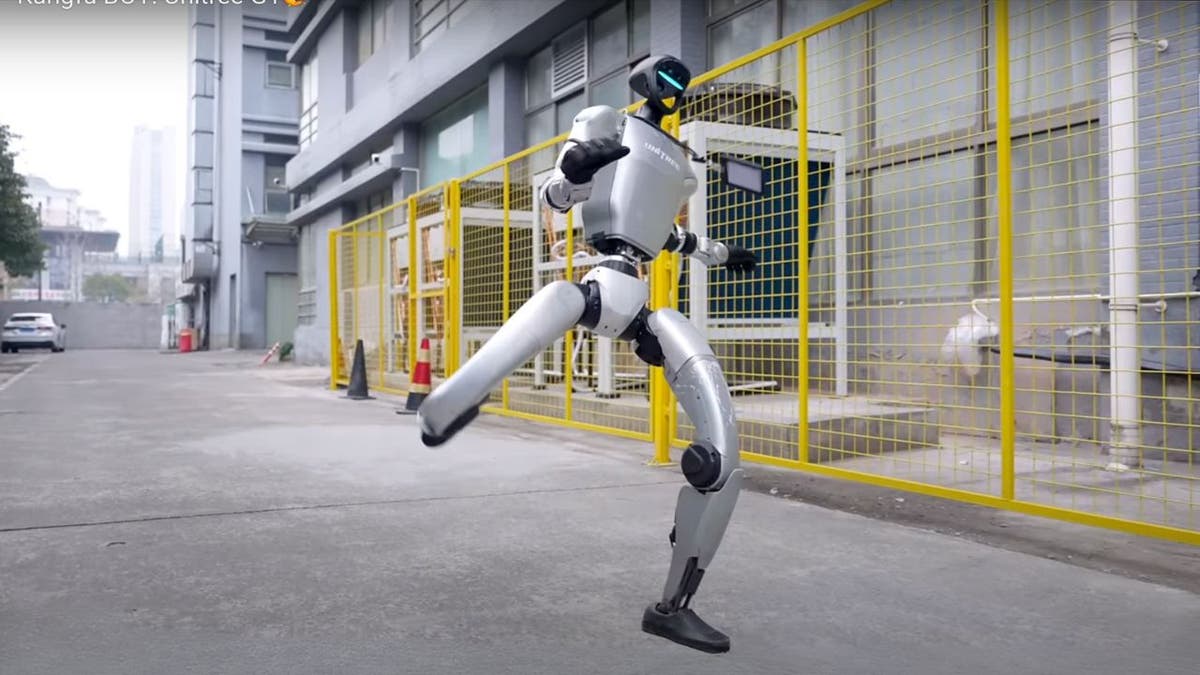
Public demonstrations amplify excitement. Robots from Unitree, AgiBot, and others appeared at the CCTV Spring Festival Gala, captivating hundreds of millions of viewers with dance routines and interactive feats. Prices have plummeted too — some models now cost under $20,000 — making widespread adoption realistic for smaller factories and service sectors.
Government Policies Fueling the Massive Robotics Revolution
Beijing’s strategic vision underpins every milestone. The “Made in China 2025” initiative identified robotics as one of ten core technologies, channeling subsidies, loans, and R&D funding nationwide. The 14th Five-Year Plan set ambitious targets for robot density and domestic production — most of which China has already surpassed.
The 2023 “Robot+” Application Action Plan expanded deployment into healthcare, agriculture, construction, and elder care. Now, the 15th Five-Year Plan (2026-2030) elevates “embodied intelligence” to a top national priority, alongside quantum computing, 6G, and brain-computer interfaces. The “AI Plus” action plan aims for AI integration across 90 percent of the economy by 2030.
State-owned enterprises must increase automation levels, while local governments build smart factories and 5G-enabled facilities. Over 230 outstanding smart factories and 1,260 5G factories emerged during the previous plan period. Public-private partnerships accelerate everything from core algorithms to humanoid prototypes.
This whole-of-nation approach creates a virtuous ecosystem. Massive computing power investments support AI training. Supply chains for actuators, sensors, and batteries achieve self-sufficiency. Talent pipelines through universities and vocational programs produce thousands of robotics engineers annually.
Leading Companies Powering Innovation and Scale
China’s robotics champions blend deep technical expertise with manufacturing agility. UBTECH, founded in 2012, pioneered consumer and industrial humanoids and became the first to list publicly in Hong Kong. Its Walker S2 model excels in collaborative factory tasks, carrying heavy loads alongside autonomous mobile robots.
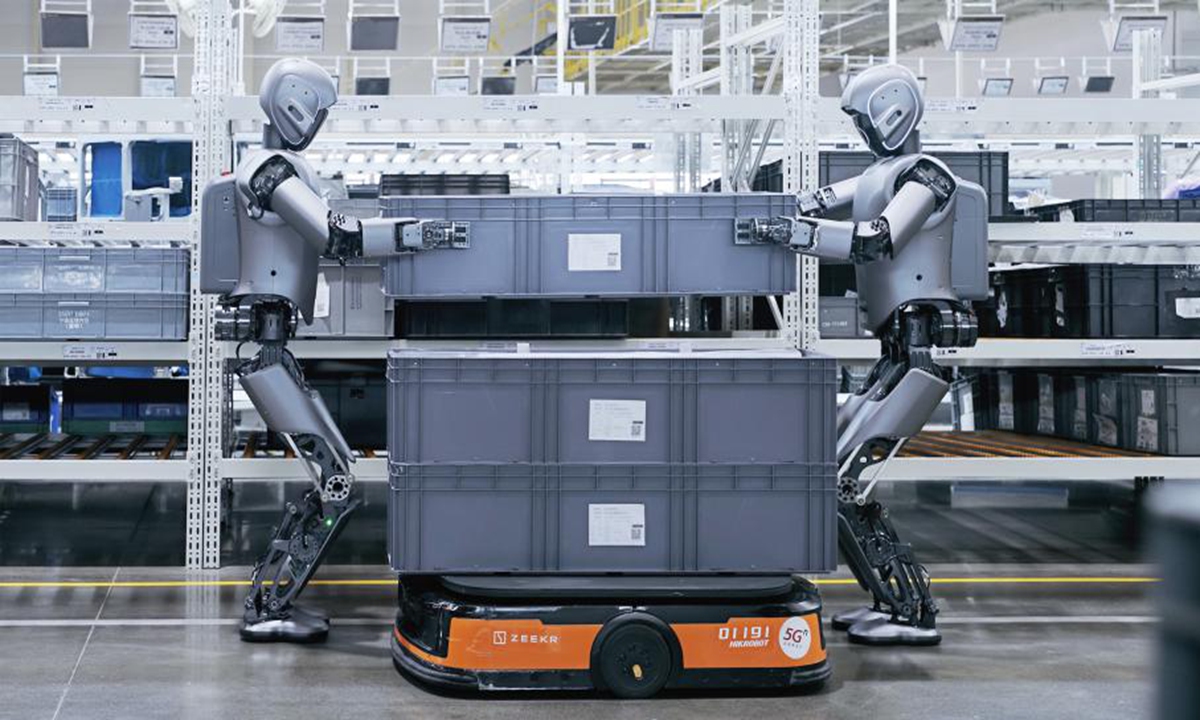
Unitree, established in 2016, gained global fame through viral videos of agile G1 robots. Aggressive pricing and rapid iteration cycles allow it to ship thousands of units yearly while eyeing 10,000-20,000 deliveries in 2026. AgiBot (Zhiyuan Robotics), a newer entrant started by ex-Huawei engineers in 2023, leads volume with efficient production scaling.
Fourier Intelligence transitioned from rehabilitation robotics to general-purpose humanoids. Its GR-2 model showcases 53 degrees of freedom and sophisticated control systems. Other rising players like Galbot and Deep Robotics secure hundreds of millions in funding, pushing valuations into billions of yuan.
These firms benefit from vertical integration. Many control their own actuator production, software stacks, and testing facilities. Speed to market outpaces Western counterparts, with new models launching in months rather than years.
Global Impact and Competitive Advantages
China’s robotics revolution extends far beyond borders. The nation now supplies robots to markets in Asia, Europe, Africa, and Latin America, challenging traditional leaders like Japan, Germany, and South Korea. Lower costs — often 30-50 percent below foreign equivalents — combined with improving quality drive adoption worldwide.
In emerging economies, Chinese robots help build local manufacturing capacity without massive upfront investment. Developed nations import them to offset labor shortages and rising wages. At international exhibitions like CES 2026, dozens of Chinese humanoid makers showcased breakthroughs, drawing attention from global executives.
Challenges remain. Quality consistency varies among smaller producers. Intellectual property concerns persist in some markets. Yet overall momentum appears unstoppable. IFR forecasts 10 percent average annual growth in Chinese robot demand through 2028, with worldwide installations surpassing 700,000 units.
Challenges and the Road to Sustainable Leadership
Labor displacement worries surface in public discourse, yet government retraining programs and new job creation in robot maintenance, programming, and AI oversight mitigate impacts. Rural-to-urban migration and aging populations actually amplify the need for automation.
Technological hurdles include achieving true general intelligence and reliable operation in unstructured environments. Energy efficiency, safety standards, and ethical guidelines require ongoing attention. China addresses these through national standards bodies and collaborative research.
Environmental benefits balance concerns. Robots optimize energy use in factories, reduce waste, and enable precise resource management. Sustainable manufacturing gains traction as automation pairs with green technologies.
Future Outlook: Even Greater Horizons Ahead
Looking into 2026 and beyond, analysts predict continued double-digit growth. The 15th Five-Year Plan will accelerate “AI Plus” applications in elderly care, logistics, and creative industries. Humanoid robots may soon handle household chores, assist in hospitals, and support education.
Projections show China’s robotics market doubling again by 2028. Embodied AI will integrate with 6G networks for real-time collaboration. Brain-computer interfaces could enable direct human-robot thought control in specialized settings.
International cooperation opportunities abound. Joint ventures, technology exchanges, and standards harmonization can benefit all nations. China’s experience offers valuable lessons in scaling automation rapidly while managing social transitions.
The explosive 2 million milestone achieved in 2024 marks only the beginning. China’s massive robotics revolution demonstrates what focused policy, industrial might, and technological ambition can accomplish. As the world watches, this transformation promises higher productivity, new capabilities, and a reimagined future of work across continents.
From humming electronics plants in Shenzhen to dynamic humanoids captivating audiences nationwide, the evidence is clear: China has not only joined the robotics revolution — it now leads it with unmatched scale, speed, and vision. Stakeholders everywhere would do well to study this model closely, for its impact will echo globally for decades to come.
Discover more from TECH-BRUNCH
Subscribe to get the latest posts sent to your email.