The game development world is undergoing a seismic shift in 2026, where artificial intelligence and no-code tools are democratizing creation like never before. Gone are the days when aspiring developers in Cape Town’s vibrant indie scene needed years of coding expertise to build their first title. Today, AI-powered no-code platforms enable anyone—from hobbyists sketching ideas on Table Mountain trails to professional studios—to prototype, iterate, and launch games in hours, not months. T
hese revolutionary tools are challenging the dominance of legacy engines like Unity, Unreal, and Godot, offering unprecedented speed, accessibility, and creativity. With the global game market projected to hit $250 billion this year, this clash between innovation and tradition is reshaping careers and fortunes.
.webp "7 Game-Changing AI No-Code Platforms Crushing Traditional Game Engines in 2026 25")
This article pits 7 explosive AI no-code platforms against the old guard, breaking down features, costs, real-world performance, and why they’re poised to dominate. Whether you’re a Western Cape coder eyeing Steam success or a non-technical creator dreaming of mobile hits, understanding this battle is essential for staying ahead.
The Dawn of Traditional Game Engines: Powerhouses Under Pressure
Traditional game development platforms have long ruled the roost. Unity, with its vast asset store and cross-platform prowess, powers hits like Genshin Impact and boasts over 70% market share among indies. Unreal Engine excels in photorealistic AAA titles such as Fortnite, thanks to Nanite and Lumen tech, while Godot’s open-source lightness appeals to solo devs crafting 2D gems like Cassette Beasts.
These engines demand scripting in C#, C++, or GDScript, steep learning curves, and hefty hardware. Unity’s past runtime fee fiasco eroded trust, Unreal’s complexity scares beginners, and Godot lags in 3D polish. In Cape Town’s Silicon Cape hubs, where resources are tight, these barriers stifle innovation—until AI no-code arrived.
Rise of AI No-Code: Empowering Creators Without Code
AI no-code platforms leverage generative models, natural language prompts, and visual builders to automate coding, assets, and logic. Tools like prompt-to-game generators create playable prototypes from text descriptions, slashing development time by 80-90%. They’re ideal for hyper-casual mobile games, web titles, and rapid prototyping, with seamless exports to iOS, Android, Steam, and web.
Here’s our top 7 game-changers dominating 2026:
1. GDevelop: The Free AI-Assisted Powerhouse
GDevelop stands tall as the ultimate no-code engine, blending drag-and-drop events with built-in AI for behaviors, assets, and tweaks.
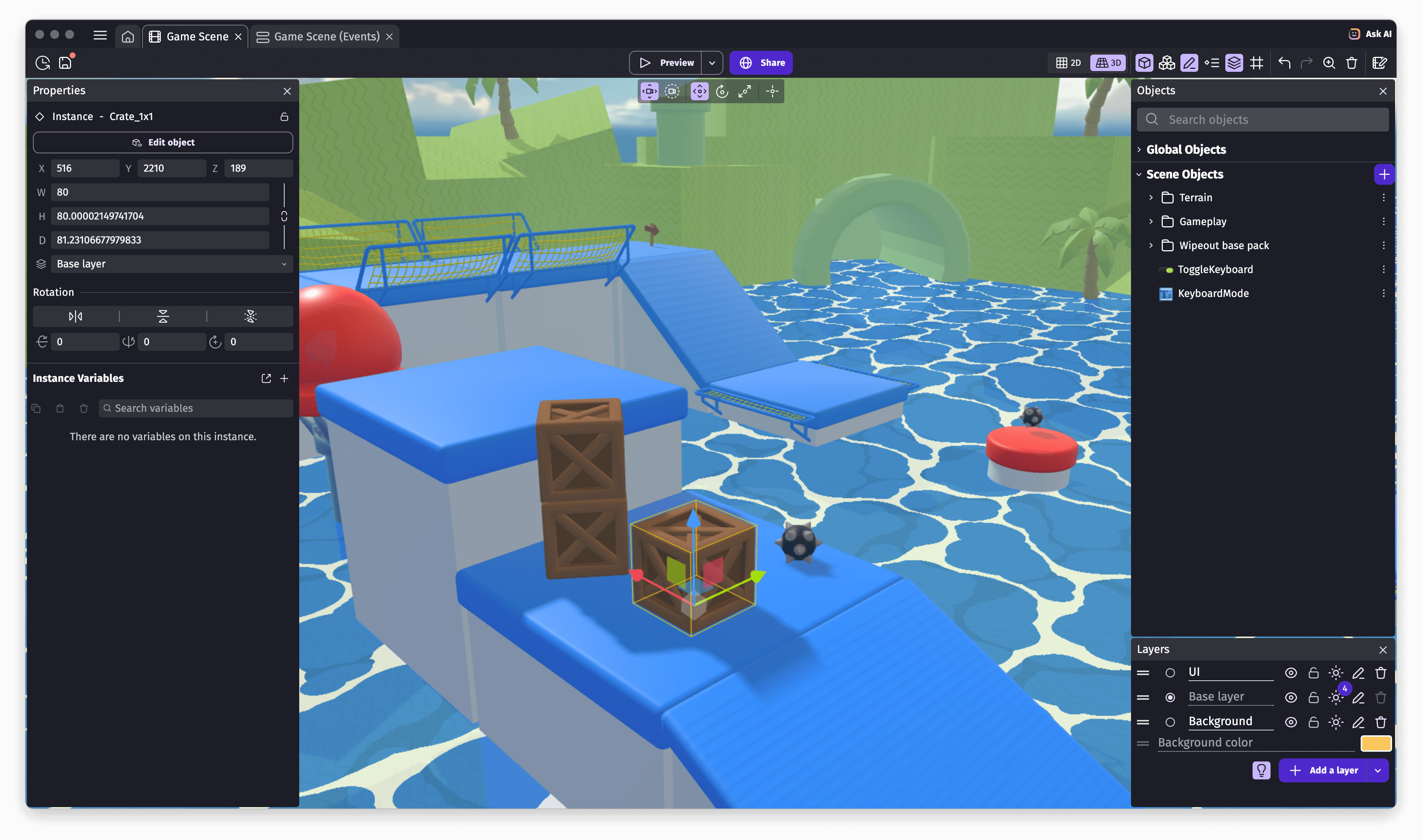
Create 2D/3D/multiplayer games via intuitive nodes—no scripting required. Its lightweight editor (under 100MB) previews instantly, unlike Unity’s 5GB behemoth. Free for most users (Pro for >$50K revenue), it exports everywhere. Cape Town educators love it for classrooms; pros use it for jams like GMTK.
2. Rosebud AI: Vibe-Code Your Dream Game
Rosebud AI revolutionizes with “vibe coding”—prompt “UFO abducting voxel cows” for instant 3D browser games.

Edit code visually, remix community projects, and publish to itch.io. Free tier for basics, Pro unlocks advanced exports. Perfect for South African indies prototyping VR experiences without rigs.
3. Buildbox: Drag-and-Drop with AI Smarts
Buildbox’s no-code UI builder crafts hyper-casual hits like Color Switch sans code. 2026 AI upgrades auto-generate animations and logic. Subscription from $99/month; one-time licenses available. Exports natively to app stores—ideal for Cape Town mobile devs chasing viral TikTok fame.
4. Ludo.ai: AI-Driven Design and Mechanics
Ludo.ai analyzes markets to suggest mechanics, generates sprites/audio, and prototypes in Unity/Godot. Not fully no-code but bridges to traditional engines. Free trial, $29/month Pro. Western Cape studios use it for data-backed hits.
5. Topvon AI: Production-Ready Code Generator
Topvon crafts GDScript/Unreal C++/web games via adaptive AI that learns your style. Outputs full projects, not demos. Pricing TBD; beta free. Game-changer for Godot fans.
6. Seele AI: One-Prompt 3D Worlds
Seele turns text into full 3D games with physics/animations. Browser-based, exportable. Emerging in 2026; free access via waitlist. Buzzing on X for “prompt-to-playable.”
7. Jenova.ai: AI-Native End-to-End
Jenova’s agents handle ideation to polish, avoiding “AI slop.” Focuses on quality casual games. Subscription model; integrates with traditional tools.
Head-to-Head: AI No-Code vs. Traditional Engines
| Feature | AI No-Code (e.g., GDevelop, Rosebud) | Traditional (Unity, Unreal, Godot) |
|---|---|---|
| Learning Curve | Minutes (prompts/drag-drop) | Weeks-Months (scripting) |
| Prototype Time | Hours | Days-Weeks |
| Cost | Free-$100/month | Free w/royalties (Unity/Unreal) or fully free (Godot) |
| Complexity Support | Casual/Indie (hyper-casual, 2D/ simple 3D) | AAA/Complex (full physics, multiplayer) |
| Asset Generation | AI-built-in | Manual/Asset Store |
| Export Platforms | Web/Mobile/Steam | All (PC/Console/VR) |
| Community/Resources | Growing (X/Discord) | Massive (forums/tutorials) |
AI no-code crushes speed and accessibility; traditional wins depth.

Pros and Cons: Choosing Your Battlefield
AI No-Code Pros: Lightning-fast iteration, zero barriers, AI assets/logic, low cost. Cons: Limited for AAA, potential “slop” without tweaks, vendor lock-in.
Traditional Pros: Unmatched power, ecosystems, scalability. Cons: Steep curve, bloat, fees.
In Cape Town’s dev meetups, hybrids rule: Prototype in Rosebud, polish in Godot.
Success Stories: From Prompt to Profit
GDevelop users shipped 10,000+ games in 2025; one Cape Town dev’s platformer hit 1M downloads. Rosebud’s voxel worlds went viral on itch.io. Buildbox alumni like Helix Jump earned millions. Even Unity’s AI prompt tool signals surrender.
The Hybrid Future: Best of Both Worlds
2026 trends point to convergence—Unity/Unreal adding prompts, Godot AI agents like Ziva. No-code for ideation, traditional for scale. For South African creators, this means more local hits amid loadshedding.
In this explosive era, AI no-code isn’t replacing traditions—it’s accelerating everyone. Dive in, prototype today, and game on.
Discover more from TECH-BRUNCH
Subscribe to get the latest posts sent to your email.