

Quantum Computing Inc. (NASDAQ: QUBT) delivered a notable 1.59% gain in recent trading, closing at approximately $9.59 per share as investors responded positively to the company’s relentless patent activity. This modest yet meaningful uptick underscores a broader narrative of strategic positioning in the hyper-competitive quantum computing arena, where intellectual property has become the ultimate battleground. With a market capitalization hovering around $1.55 billion and robust cash reserves exceeding $737 million following a major fundraising round, QUBT stands out as a pure-play innovator leveraging photonics-based solutions to tackle real-world optimization challenges.
The surge arrives amid a wave of industry-wide patent filings that have skyrocketed in recent years, positioning forward-thinking firms like QUBT to capture significant market share as quantum technologies transition from laboratory curiosities to commercial powerhouses. Unlike many peers wrestling with cryogenic complexities, QUBT’s focus on room-temperature photonic systems offers a practical edge, appealing to enterprises seeking scalable, energy-efficient quantum tools without the overhead of extreme cooling requirements.
QUBT’s Latest Performance: Momentum Builds on Solid Fundamentals
Trading volume reached $22 million in the session, reflecting heightened investor interest as QUBT shares climbed above key short- and medium-term moving averages. The stock now sits comfortably over its 20-day simple moving average of $7.27 and 50-day SMA of $7.79, signaling sustained bullish sentiment despite lingering pressure from the 200-day SMA at $13.24.
This performance isn’t isolated. QUBT’s recent commercial milestone—the inaugural deployment of its Dirac-3 quantum optimization machine onto the Quantum Corridor interstate quantum-safe network—has fueled optimism. Announced just days prior, this installation marks the company’s first data-center integration of its proprietary hardware, demonstrating real-world viability for quantum-accelerated problem-solving in logistics, finance, and supply chain optimization.
Financially, the picture remains intriguing. Latest quarterly figures reveal $198,000 in revenue, a figure that highlights the pre-commercial stage of many quantum ventures. Yet the balance sheet tells a different story: minimal debt paired with substantial liquidity provides runway for aggressive R&D and strategic acquisitions. Analysts view this cash hoard as a critical buffer, enabling QUBT to weather volatility while competitors scramble for funding.

The Patent Engine Driving QUBT’s Strategic Edge
Ongoing patent activity forms the heartbeat of QUBT’s ascent. The company has steadily expanded its intellectual property portfolio with innovations in quantum optics, remote sensing, variational analog quantum oracles, and machine learning mappings tailored for quantum processing units. These filings aren’t mere paperwork—they represent defensible moats in a sector where technological breakthroughs can be replicated overnight without robust protection.
Recent grants, including systems for two-photon population inversion in remote sensing and surface profiling, highlight QUBT’s pivot toward practical applications. These patents enhance capabilities in object identification and aiming technologies, areas with immediate relevance to defense, aerospace, and industrial sectors. By securing rights to these foundational methods, QUBT strengthens its bargaining position in partnerships and licensing deals.
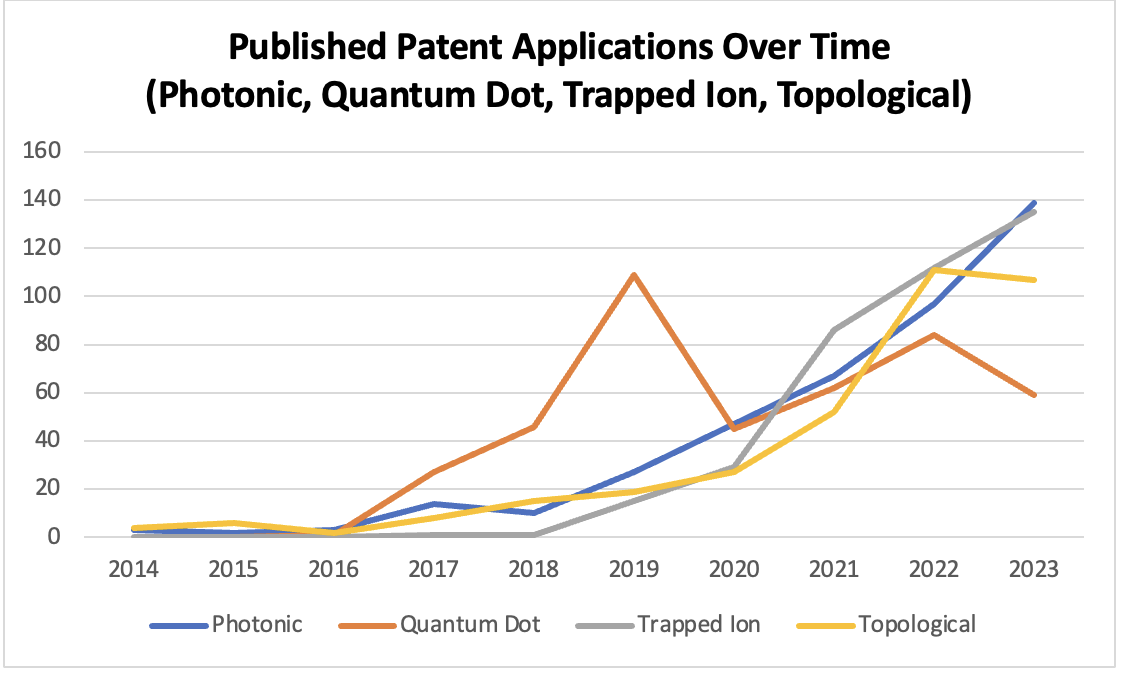
Patent trends across the quantum ecosystem reinforce this momentum. Global filings have more than doubled in recent years, with photonic approaches gaining traction for their stability and integration potential. QUBT’s emphasis on photonics aligns perfectly with this shift, distinguishing it from qubit-heavy rivals reliant on superconducting or trapped-ion architectures.
“If QUBT can consolidate these gains without a sharp correction, I see a strong foundation for further upside in the coming weeks,” noted Viktoras Karapetjanc, analyst at Traders Union. He highlights the successful Dirac-3 deployment and cash position as key drivers, though he cautions on overbought technical indicators like RSI near 71.
Strategic Acquisitions Amplify Patent Portfolio and Market Reach
QUBT hasn’t stopped at organic innovation. Strategic purchases have turbocharged its IP strength and operational capabilities. The $110 million all-cash acquisition of Luminar Semiconductor, Inc.—a subsidiary of Luminar Technologies—brings advanced photonic components, lasers, detectors, and manufacturing expertise under the QUBT umbrella. This move creates vertical integration across the photonics value chain, accelerating product roadmaps while adding established customer relationships in aerospace and defense.
Complementing this, the $5 million acquisition of NuCrypt, LLC, injects quantum communications technologies and additional patents in quantum optics and RF-photonics. Together, these deals position QUBT as a vertically integrated player capable of delivering end-to-end solutions—from hardware fabrication to secure networking—reducing supply chain vulnerabilities in an era of geopolitical tensions over critical technologies.
These acquisitions aren’t just additive; they transform QUBT’s strategic posture. By incorporating patented thin-film lithium niobate platforms and photonic signal processing, the company now offers hybrid quantum-photonic systems that operate at room temperature, a rarity that lowers deployment barriers for enterprise clients.
“These transactions provide near-term revenue visibility and create a strategic foundation for QCi to expand its technology offerings into established sectors over time,” stated company leadership in recent announcements detailing the deals.
Dirac-3 Deployment: From Theory to Tangible Commercial Progress
The Dirac-3 quantum optimization machine’s placement on the Quantum Corridor network represents a pivotal leap. Unlike traditional quantum computers requiring specialized environments, Dirac-3 leverages QUBT’s photonic architecture for seamless integration into existing data centers. This deployment enables quantum-accelerated optimization for complex problems previously intractable with classical computing, such as route planning for logistics giants or portfolio risk modeling for financial institutions.
Early feedback from the Quantum Corridor pilot suggests measurable efficiency gains, validating QUBT’s claim that accessible quantum tools can deliver immediate ROI. The system joins a growing roster of QUBT hardware, including entropy-based computing solutions and quantum-secure communications prototypes demonstrated in partnership with industry leaders like Ciena at major conferences.
This milestone aligns with broader industry commercialization efforts. While giants like IBM and Google dominate patent volume, pure-plays like QUBT focus on niche, deployable applications that bridge the gap between research and revenue.
“Patent activity continues to contribute to the company’s strategic positioning,” emphasized recent market analysis, underscoring how IP filings directly correlate with investor confidence and long-term valuation potential.
Quantum Computing Market Landscape: Opportunities and Competitive Dynamics
The global quantum computing market is projected to explode from roughly $2 billion in 2026 toward $18 billion by 2030, driven by a 31% compound annual growth rate. Applications span drug discovery, materials science, cryptography, and artificial intelligence enhancement—sectors where even marginal quantum advantages yield billions in economic impact.
QUBT operates in a crowded field alongside IonQ, Rigetti Computing, and D-Wave Quantum. Yet its photonics-first approach and recent patent-fueled acquisitions carve a distinctive lane. While competitors chase qubit scaling, QUBT prioritizes hybrid systems that integrate with classical infrastructure, appealing to risk-averse enterprises wary of cryogenic overhead.
Geopolitical factors add tailwinds. With nations racing to secure quantum supremacy, U.S.-based innovators like QUBT benefit from domestic supply chain initiatives and potential government contracts. Patent leadership helps mitigate infringement risks while opening doors to international licensing.

Challenges on the Horizon: Revenue Realization and Sector Volatility
Despite the positives, hurdles remain. QUBT’s revenue base stays modest, reflecting the sector’s long commercialization runway. Technical risks—error correction, scalability, and integration—persist across quantum technologies. Market volatility, fueled by headline-driven trading, demands disciplined execution.
Overbought conditions signal potential near-term consolidation, with analysts forecasting modest pullbacks before renewed momentum. Long-term success hinges on converting patents into recurring revenue streams and scaling deployments beyond pilots.
Investor Takeaways: Why Patent Momentum Matters More Than Ever
For investors eyeing QUBT, the 1.59% surge symbolizes deeper resilience. Strong cash reserves provide optionality for further R&D or tuck-in acquisitions. Patent depth insulates against copycat threats while enhancing appeal to strategic buyers or partners.
As quantum adoption accelerates, companies with defensible IP portfolios will command premium valuations. QUBT’s trajectory—from innovative filings to commercial deployments—positions it as a compelling pure-play in a transformative industry.
“Quantum patents are soaring, with the total number increasing fivefold from 2014 to 2024,” observed researchers in recent MIT-affiliated reports, a trend that bodes well for IP-rich players like QUBT.
“The rise in patent filings mirrors our experience of an increasing number of quantum technology start-ups seeking IP advice,” added experts tracking the European and global patent landscape, highlighting the innovation boom QUBT actively rides.
Looking Forward: QUBT’s Path to Quantum Leadership
QUBT’s patent-driven strategy, bolstered by acquisitions and successful deployments, paints an optimistic picture. As the quantum era unfolds, ongoing IP activity will remain central to sustaining competitive advantages and unlocking shareholder value.
Investors should monitor upcoming earnings for revenue traction from new photonic offerings and potential defence contracts. With the stock demonstrating short-term strength and a clear innovation roadmap, QUBT exemplifies how targeted patent activity can propel a specialized player forward in one of technology’s most promising frontiers
In summary, the explosive 1.59% gain reflects more than fleeting market sentiment—it signals confidence in QUBT’s fortified strategic position. As patent portfolios deepen and commercial milestones multiply, the company stands poised to capture meaningful share in the quantum revolution, delivering both technological breakthroughs and investment upside for those attuned to this high-potential sector.


